Taking the hassle out of Hörspielproduktion
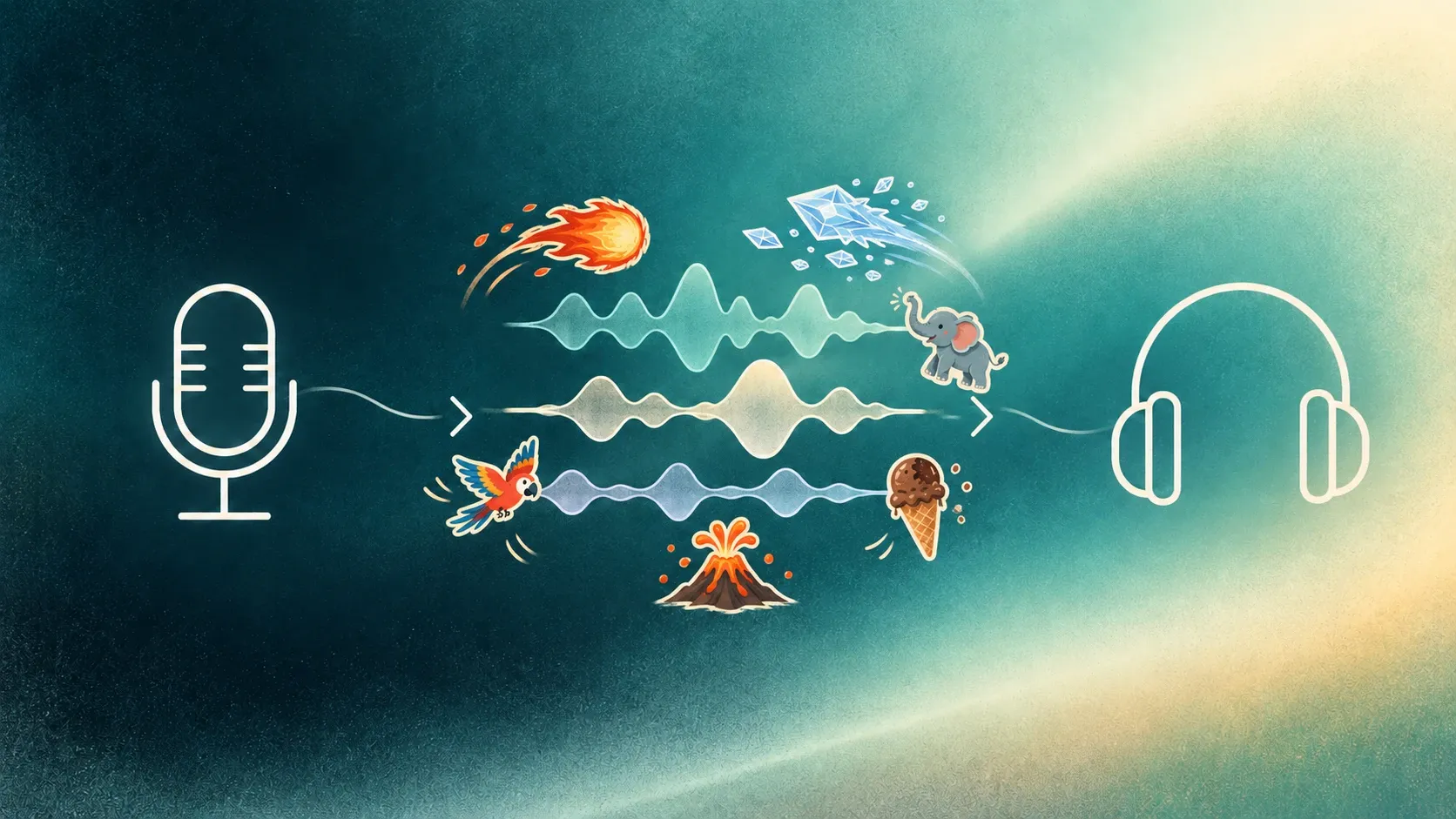
When I visit my nephews and nieces, I usually end up telling them made-up stories. At my sister’s house, these often take place in the same universe: my children, nephews, and nieces are superheroes, each with their own special powers. We’ve been building this world for a few years now.
The powers are fairly simple: jumping really high, shooting ice, talking to animals. We started with four superheroes. Now there are seven, and probably more to come. Keeping everything consistent is getting harder, but the kids help me. They remember what happened. And they like running around playing their characters.
I really like these stories. And I like Hörspiele (audio plays). My kids listen to so many of them: Die drei Fragezeichen Kids, TKKG Junior, Die Fuchsbande, and all kinds of stories involving girls and horses.
We’ve recorded our own before, too. Usually improvised: press record, start talking, and see where the story goes. That’s a lot of fun. Last week, during the school holidays, we tried something with a proper script and a bit more production.
From ideas to a script
Usually, I tell the stories. This time, I wanted the kids to help invent one. We talked through the adventure together: what should happen next? What should the villain be called? How did he become a villain?
I recorded that conversation and gave it to an LLM, together with some context about our superhero universe: names, ages, relationships, powers. Basically an AGENTS.md for the story.
With the overall story in place, I asked it to create a script.
That was already a big help. Writing dialogue for around ten speakers, balancing their parts, and making the whole thing funny takes a long time by hand. The older children can handle longer sentences. The younger ones need shorter lines. Everyone should get something interesting to do.
I read through the script and did a few rounds of changes, fixing things that didn’t make sense or didn’t fit our characters. I did that part myself. The kids wanted to play, which seemed fair enough.
If the kids were older, I’d involve them in this part too. They could help revise the dialogue or write the initial prompt about what kind of story they want.
There’s also something nice about them not knowing all the dialogue beforehand. Even while recording, everyone only hears their own part, so the finished Hörspiel still has some surprises.
Recording under a table
Once the script was ready, I had the LLM create a recording sheet for each speaker, with directions about how to say the lines.
Unfortunately, I hadn’t brought my proper microphone. So we sat under a table with a blanket over it to reduce the echo and spoke into an iPhone.
Very professional. Also cosy, warm, and quite uncomfortable.
We recorded each person on their own named track in Audacity. I’d read a line and explain the feeling: scared, excited, trying to sound brave. Then they’d say it. Long sentences could be split up.
If something went wrong, we tried again. Just leave it running. We’ll clean it up later. Recording took about 30–45 minutes, including all the repeated lines.
Putting it together
The title song came from Suno, with lyrics based on the story. I gave it to an AI agent along with the recordings, the final script, and the stage directions. It could work with the files on my Mac and control Audacity through its scripting interface. The script told it who should speak when, and the stage directions helped with what was happening in each scene.
My prompt was roughly:
Assemble a Hörspiel from these named speaker tracks, following the script and stage directions. Usually use the last take and remove my coaching. Clean up the sound, add Pixabay effects, keep backgrounds quiet, and use our song at the beginning and end. Save an editable Audacity project and an MP3.
The agent added sound effects from Pixabay. A volcano does need to sound like a volcano.
The agent worked on the edit for roughly 45 minutes. The finished Hörspiel was about 14 minutes long. Afterwards, I listened back and asked for another pass. Some background sounds were too loud, a few pauses needed more room, and there were a handful of cuts to fix. Those follow-up changes only took a few minutes.
I really liked having the Audacity project. I could see what the agent had done and fine-tune things myself. A pause or a sound effect is something I can just change directly, without another round of prompting.
While the agent was doing the editing, I could spend time with the kids. That’s what made the whole thing work for me.
What I want to keep
The LLM contributed creatively. It wrote dialogue and added details and jokes to the story. I’m happy to get help with that, but I want to keep coming up with the stories together: the children’s ideas, our characters, that first spark of an adventure.
The details are often what make a story great. Next time, I’d like to spend more time shaping the script from the first draft the LLM gives me. Writing it together with the kids could be fun too, when they’re older.
I don’t miss the editing. We had around ten speakers, each with their own track, plus music and sound effects. For me, that was already a huge Audacity project. Spending less time at the computer and more time with the kids feels quite freeing. Touching some grass.
And of course, we recorded a long laugh for the ending. As seems to be required in every Hörspiel I know.
I’m really happy with how this turned out. The recordings could easily have ended up sitting on my computer, waiting for an evening when I had time to edit them. This feels like a very good use of AI to me.
The kids had a Hörspiel of their own to listen to.
And they’ve been listening. Twice a day, every day since.
I used AI to help write this article. The ideas, experiences, and train of thought are mine, and I edited and revised the draft extensively over several rounds.